As I mentioned in my previous post, 6-Meters was not very cooperative during Field Day this year. Last year at the ARCS Field Day, we worked over 100 stations on 6-Meters on Sunday Morning, including approximately 70 in an hour. This year was just about the polar opposite.
Last evening, while catching up on email from the weekend and generally just recovering from Field Day, a friend from Florida mentioned in an IM that he was getting some possible low band DX from Canada. That was about the only thing radio related that could have piqued my interest at the time, so I hooked up the triband vertical and fired up the FT-897D. Sure enough, now that Field Day was over, 6-Meters was open. What else could you expect! During a QSO with Mike, WD8OST I found that we weren't the only ones to have no luck on 6 during Field Day; apparently not very many others did either.
The opening last night was a pretty good to the north. Prior to calling the CARS Sunday Night Net, I worked the following stations:
VE2RA - Quebec
VE1GBD - Nova Scotia
K2LTS - New York
N8OC - Michigan
WD8OST - Michigan
W0VB - Minnesota
VE2NRG - Quebec
Mac McCormick III, KF4LMT
kf4lmt@comcast.net
Showing posts with label Field Day. Show all posts
Showing posts with label Field Day. Show all posts
29 June 2009
Field Day 2009
This year, I operated Field Day from the Coastal Amateur Radio Society Field Day and from home. I intended to operate from the Amateur Radio Club of Savannah Field Day, but never got around to operating after I got there. I talked with one of my "elmers," Ed Woodson, NC5S who I hadn't seen in probably a year and Stacy Aaron, WA4IDS for a couple of hours.
Unfortunately, 6 Meters didn't open up very much or very well while I was at the radios during Field Day. HF propagation didn't seem to be all that good either.
At CARS, I operated some some 20-Meters and 40-Meters during the "Midnight Shift" but mostly worked some 15-Meters Saturday afternoon. On both bands, most of the propagation seemed to favor the northeast, although I did work a few stations in Texas and Louisiana on 15 Meters.
For the first time (mostly because this is the first Field Day I've had HF privileges) I worked Field Day from home as a 1E station. Due to unforeseen circumstances, I missed the beginning of field day this year and wasn't able to start until late afternoon. A couple of hours before going over to the CARS Field Day was my 1E operating time. 6-Meter and 80-Meter propagation was very poor at the time with no contacts on either band. 10-Meters was also poor, but I did make one contact on that band. 20, 40, and 15-Meters were decent and most of my contacts were made there:
10-Meters
W1UR - 2A NH
20-Meters
K5ENS - 1D LA
W4AVA - 3A VA
W3AO - 20A MDC (National Press Radio Club)
W2EA - 6A SNJ
KB8UHN - 1E OH
K1R - 5A NH
WA3COM - 4A PA
15-Meters
KW2O - 2A NLI
K1BKE - 4A NH
W1AW - 3F CT (ARRL HQ Station)
W1TJL - 1E CT
VE3WE - 8A ON
40-Meters
W6SAI - 1E AL
W4TRC - 2A TN
K4F - 2A NFL
W4V - 3D AL
W4UD - 3A TN
KJ4LEL - 2D AL
W4DW - 7A NC
K4BFT - 4A AL
N4UED - 1E NC
W2CB - 3A SFL
W4LX - 4A SFL
Mac McCormick III, KF4LMT
kf4lmt@comcast.net
Unfortunately, 6 Meters didn't open up very much or very well while I was at the radios during Field Day. HF propagation didn't seem to be all that good either.
At CARS, I operated some some 20-Meters and 40-Meters during the "Midnight Shift" but mostly worked some 15-Meters Saturday afternoon. On both bands, most of the propagation seemed to favor the northeast, although I did work a few stations in Texas and Louisiana on 15 Meters.
For the first time (mostly because this is the first Field Day I've had HF privileges) I worked Field Day from home as a 1E station. Due to unforeseen circumstances, I missed the beginning of field day this year and wasn't able to start until late afternoon. A couple of hours before going over to the CARS Field Day was my 1E operating time. 6-Meter and 80-Meter propagation was very poor at the time with no contacts on either band. 10-Meters was also poor, but I did make one contact on that band. 20, 40, and 15-Meters were decent and most of my contacts were made there:
10-Meters
W1UR - 2A NH
20-Meters
K5ENS - 1D LA
W4AVA - 3A VA
W3AO - 20A MDC (National Press Radio Club)
W2EA - 6A SNJ
KB8UHN - 1E OH
K1R - 5A NH
WA3COM - 4A PA
15-Meters
KW2O - 2A NLI
K1BKE - 4A NH
W1AW - 3F CT (ARRL HQ Station)
W1TJL - 1E CT
VE3WE - 8A ON
40-Meters
W6SAI - 1E AL
W4TRC - 2A TN
K4F - 2A NFL
W4V - 3D AL
W4UD - 3A TN
KJ4LEL - 2D AL
W4DW - 7A NC
K4BFT - 4A AL
N4UED - 1E NC
W2CB - 3A SFL
W4LX - 4A SFL
Mac McCormick III, KF4LMT
kf4lmt@comcast.net


23 June 2009
Field Day - Over 35,000 radio "hams" active June 27-28
ARRL National News Release
Thousands of Amateur Radio operators, often called “hams,” will be showing off their wireless capabilities June 27-28. Erecting radio stations in community parks, campgrounds, schools and emergency centers throughout the country, they will hold a “Field Day” and show their emergency communications abilities while having fun talking to friends all over the continent with their radios.
Over the past months, the news has been full of reports of ham radio operators providing critical communications in emergencies world-wide. During fires, hurricanes, tornados and other crises, Amateur Radio was often the only way by which people could communicate. Amateur Radio operators are often the first to provide information and observations to responders in crisis situations. FEMA, DHS, the National Weather Service, and emergency management offices have the Amateur Radio Emergency Services (ARES®) operators in their emergency communications plans. On June 27-28, the public will have a chance to meet and talk with the hams and see for themselves what the Amateur Radio Service is about as they display their digital and satellite capabilities, voice communications, wireless, radio and Web hybrid systems, and even historic Morse code.
To find out where the Amateur Radio operators will be set up in your area, go to www.ARRL.org/fieldday.
The event, called "Field Day" is the climax of "Amateur Radio Week" sponsored by ARRL, the National Association for Amateur Radio. Using only emergency power, ham operators will construct temporary stations around the country for the weekend and send messages in many forms without the use of phone systems, internet or other infrastructure that can be compromised in a crisis. More than 35,000 amateur radio operators across the country participated in last year's event.
Amateur Radio is growing in the United States. In just the past 4 years over 100,000 new people earned their first Amateur Radio Service license from the FCC.
Almost 50% of US Amateur Radio operators have now gone far beyond the entry level licensing requirements for Amateur Radio and earned higher class FCC licenses.
There are more than 660,000 Amateur Radio operators in the US, and 2.5 million around the world.
To learn more about Amateur Radio, go to www.WeDoThat-Radio.org. The public is most cordially invited to come, meet and talk with the hams. See what modern Amateur Radio can do. They can even help you get on the air!
I'll be operating Field Day from the Coastal Amateur Radio Society Field Day using callsign K4S and from the Amateur Radio Club of Savannah Field Day using callsign W4HBB, mostly during the "midnight shift." I also plan on doing some Field Day operations from home this year using my callsign: KF4LMT.
Thousands of Amateur Radio operators, often called “hams,” will be showing off their wireless capabilities June 27-28. Erecting radio stations in community parks, campgrounds, schools and emergency centers throughout the country, they will hold a “Field Day” and show their emergency communications abilities while having fun talking to friends all over the continent with their radios.
Over the past months, the news has been full of reports of ham radio operators providing critical communications in emergencies world-wide. During fires, hurricanes, tornados and other crises, Amateur Radio was often the only way by which people could communicate. Amateur Radio operators are often the first to provide information and observations to responders in crisis situations. FEMA, DHS, the National Weather Service, and emergency management offices have the Amateur Radio Emergency Services (ARES®) operators in their emergency communications plans. On June 27-28, the public will have a chance to meet and talk with the hams and see for themselves what the Amateur Radio Service is about as they display their digital and satellite capabilities, voice communications, wireless, radio and Web hybrid systems, and even historic Morse code.
To find out where the Amateur Radio operators will be set up in your area, go to www.ARRL.org/fieldday.
The event, called "Field Day" is the climax of "Amateur Radio Week" sponsored by ARRL, the National Association for Amateur Radio. Using only emergency power, ham operators will construct temporary stations around the country for the weekend and send messages in many forms without the use of phone systems, internet or other infrastructure that can be compromised in a crisis. More than 35,000 amateur radio operators across the country participated in last year's event.
Amateur Radio is growing in the United States. In just the past 4 years over 100,000 new people earned their first Amateur Radio Service license from the FCC.
Almost 50% of US Amateur Radio operators have now gone far beyond the entry level licensing requirements for Amateur Radio and earned higher class FCC licenses.
There are more than 660,000 Amateur Radio operators in the US, and 2.5 million around the world.
To learn more about Amateur Radio, go to www.WeDoThat-Radio.org. The public is most cordially invited to come, meet and talk with the hams. See what modern Amateur Radio can do. They can even help you get on the air!
I'll be operating Field Day from the Coastal Amateur Radio Society Field Day using callsign K4S and from the Amateur Radio Club of Savannah Field Day using callsign W4HBB, mostly during the "midnight shift." I also plan on doing some Field Day operations from home this year using my callsign: KF4LMT.
30 June 2008
Field Day 2008
Field Day 2008 has come and gone. As usual, I attended the Amateur Radio Club of Savannah (ARCS) Field Day out at the Georgia Air National Guard Pavilion at the Savannah CRTC.

 Some of the Antennas: The large rotatable dipole is for 10/15/20-meters. The ground plane antenna on the left is for 6-meters, with the 6m/2m rotatable dipole beneath it. The white vertical sticking up above the roof is the Echolink Node antenna. Just visible towards the front of the building (we're looking at the rear) is the 2-meter vertical antenna for the talk-in radio.


I really enjoyed Field Day this year, more so than I have previous years. I worked HF more than I have in previous Field Days, but I think the mini pile-up I worked on 50.140 USB was the highlight of my Field Day. Those of us in attendance enjoyed a couple of meals together and enjoyed just hanging out trading stories through the weekend.
Mac McCormick, KF4LMT
kf4lmt@comcast.net
Some of the Antennas: The large rotatable dipole is for 10/15/20-meters. The ground plane antenna on the left is for 6-meters, with the 6m/2m rotatable dipole beneath it. The white vertical sticking up above the roof is the Echolink Node antenna. Just visible towards the front of the building (we're looking at the rear) is the 2-meter vertical antenna for the talk-in radio.
Dan, KF4MND, sets up the Echolink Node.
We began setting up at 1000 on Saturday morning. The first thing to go up were antennas: A 2-meter vertical for a talk-in station, a dual band 2m/70cm for an Echolink Node, two 10/15/20 meter rotatable dipoles, a 6-meter ground plane, a 2m/6m rotatable dipole, an 80-meter dipole, and a 40-meter dipole. 3 HF radios were set up inside the pavilion, equating roughly to one 40-meter station, one 80-meter station, and one 10/15/20 meter station. There was also a 6m/2m station, an Echolink Node, and a 2-meter talk-in station. We operated as a 3A GA station, meaning 3 transmitters running off of battery power, limiting to three the number of transmitters on the air at any given time.

Stacy, WA4IDS and sons working 80-meters.

Andy, WD4AFY working 40-meters.
Ken, VE2HFX working 6-meters.
I'm working 20-meters around 0200.
Despite lower attendance than last year, we had a quality Field Day Operation. It would probably not be up to snuff for a contester, but that really wasn't we were geared to. Our Field Day was more about practice and training in setting stations in an environment other than the home. A of this is that three of our antenna masts were raised by placing them on kick-outs we had hammered into the ground and then lashing them to the exposed roof rafters of the pavilion with parachute cord or heavy wire. During the daytime, we were able to keep three transmitters on the air until late Sunday. During the night, I stayed awake and moved between the 20-meter and 80-meter stations trying to keep us on the air, collecting just over a page worth of logs on 20-meters and 3/4 of a page on 80-meters.
Saturday morning brought an excellent 6-meter band opening around 0830. After making a contact with a Canadian maritime station, I started calling CQ on 50.140 USB and worked 75 stations in just over one hour and fifteen minutes, almost averaging one contact a minute. The band was open into the northeastern US and Canada. After my throat got scratchy and needed a break, Ken Jeffers, VE2HFX took over on 6-meters. Ken continues working into the northeast and to the west as the band opened that way, adding to our tally of 6-meter contacts. By the time the band started fading in and out on us, we had logged well over 1oo stations on 6-meters. By far it was the best 6-meter haul we've had in recent Field Day operations.
Early Saturday morning, I traveled west to the Effingham County ARES (ECARES) Field Day site at Lakeview Community Park in Faulkville. ECARES truly had a field set-up for their Field Day, working out of tents for their operating, eating, and sleeping areas. Unfortunately, I left my camera at the ARCS site, so I don't have any pictures.
Sadly, I never found the time to get out to the Coastal Amateur Radio Society (CARS) Field Day at Southside Fire Station #1. I missed being able to get out there and visit with the CARS bunch for awhile. Mark Bolton, KA4CID, had provided a solar trailer to power the radios and I would have loved to have seen that operation. During the daytime, we were able to keep three transmitters on the air until late Sunday.
Mary, KD4DOY and sons; Kurt, N4CVF; Ed, NC5S; and Stacy, WA4IDS and son.
Ed, NC5S; Irene; KF4RFF; and Mac, AF4KL
Mark, KD4PDX shows his renowned enthusiasm.
Irene, KF4RFF; Beth Ann, KI4ZDN; and Andy, WD4AFY enjoy lunch while we wait on the rain to stop to take down the antennas on Saturday afternoon.
I really enjoyed Field Day this year, more so than I have previous years. I worked HF more than I have in previous Field Days, but I think the mini pile-up I worked on 50.140 USB was the highlight of my Field Day. Those of us in attendance enjoyed a couple of meals together and enjoyed just hanging out trading stories through the weekend.
Mac McCormick, KF4LMT
kf4lmt@comcast.net
24 June 2007
Amateur Radio Club of Savannah Field Day 2007, Part II
Making an appearance at Field Day were some military radios, both current and past. It was interesting to be able to compare and contrast the amateur and military equipment and get to hear the current military equipment operate.


Former Military HF Radio operated by Philip, KA4KOE
Military VHF/UHF radio
Military HF Radio
Unusual for me, I did operate some HF this year, covering 20-meter USB while some of the more HF-oriented operators took a break. To prove it, someone took this photo (if it doesn't break Blogger's servers... It didn't break the camera...):

I tried several times to work 6-meters this year, but it just never seemed that propagation would cooperate with us. I always enjoy working 6-meters, but sometimes luck just isn't with us. All in all, though, I think good fun was had by all. We may have not made the most contacts, but we had a good variety of equipment, from older military and amateur gear to the latest and greatest gear. We also had a good variety of antennas up, including verticals, wire antennas, trap dipoles, and a NVIS antenna. I can also say that there was good fellowship with fellow hams; there was a good group assembled for dinner and a small but solid core of operators throughout Saturday afternoon and Sunday morning and afternoon.
As always, you can find things that need improvement. Next year, I think we need to be more serious about operating through the night (and I include myself in that assessment). I would also like to see more "elmering" going on during field day. It should not just be left up to newer hams to ask for advice and suggestions, but the more experienced hams should offer it. When I was first licensed, I was thankful for the operating tips, advice, and impromptu lessons from experienced operators.
Mac McCormick, KF4LMT
kf4lmt@comcast.net
23 June 2007
Amateur Radio Club of Savannah Field Day 2007, Part I
Field Day 2007 started well for the Amateur Radio Club of Savannah. Here are some photos from early in the day, right around the time the radios got cranked up. Following photos of some of the operators are photos of the field day site itself.
 Mac, AF4KL, making contacts
 Dan, KF4MND, making contacts
 Philip, KA4KOE, making contacts
 Ken, VE2HFX, and Kurt, N4CVF investigating Ken's TS-700
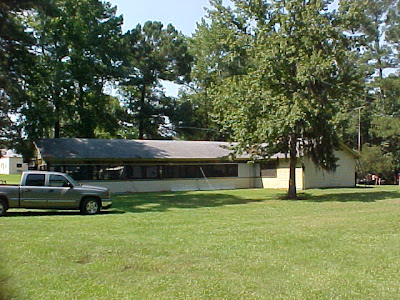
Below are photos of the ARCS Field Day at the GA Air National Guard Pavilion (Part of the Savannah CRTC) near the Savannah International Airport. Several trap dipoles were raised, along with a wire dipole, an 80-meter "tape measure" dipole, a military NVIS antenna, a military AT-1011 whip, a 6-meter vertical, a 2-meter ground plane, and a dual-band yagi.


Mac McCormick, KF4LMT
 Mac, AF4KL, making contacts
  Dan, KF4MND, making contacts
  Philip, KA4KOE, making contacts
  Ken, VE2HFX, and Kurt, N4CVF investigating Ken's TS-700
 Below are photos of the ARCS Field Day at the GA Air National Guard Pavilion (Part of the Savannah CRTC) near the Savannah International Airport. Several trap dipoles were raised, along with a wire dipole, an 80-meter "tape measure" dipole, a military NVIS antenna, a military AT-1011 whip, a 6-meter vertical, a 2-meter ground plane, and a dual-band yagi.


Mac McCormick, KF4LMT
Subscribe to:
Posts (Atom)


